


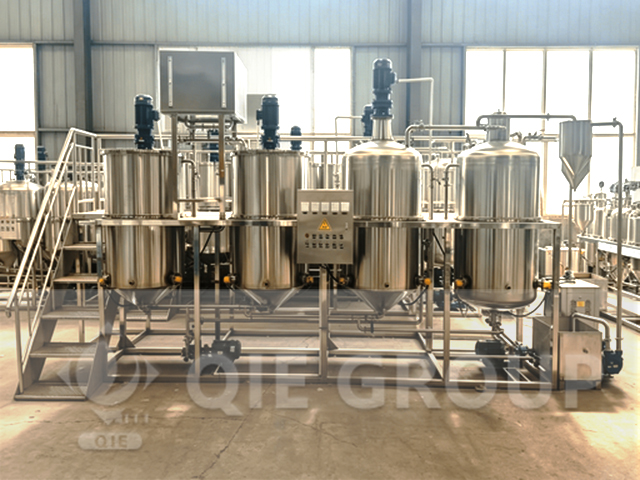
Sesame Oil Refinery Machine
Overview of Sesame Oil Refining Machine
The sesame oil refining unit is a complete set of equipment for deep processing at the back end of the sesame oil production line. Crude sesame oil, after being coarsely filtered by the sesame oil filter, still contains gums, free fatty acids, pigments, waxes, and trace amounts of off-odor substances. These components can lead to a high acid value, dark color, fogging at low temperatures, and a short shelf life, making it unable to meet the national standard for first-grade refined sesame oil for bottling and export.
Sesame oil refining units employ a combination of physical and chemical refining processes, and are categorized into two main types based on their operation: intermittent refining units and semi-continuous refining units. The equipment can be purchased as individual units or delivered as a complete set, and is used to produce light-colored, highly stable refined sesame oil.
Important process notes: Traditional stone mill sesame oil is generally not refined, as refining will result in the loss of most of the characteristic caramel flavor; refining units are mostly used for export-grade bottled first-grade sesame oil and pressed oil made from peeled sesame kernels.
Production line process location
Sesame seed washing machine → Sesame hulling machine (optional) → Bucket elevator → Sesame roasting machine → Sesame oil press → Sesame oil filter → Sesame oil refining unit (optional process for this equipment) → Terminal bag filter → Finished oil storage tank and filling system
Process Description: Refining is an optional step. If the customer’s main product is traditional, strong-aroma sesame oil produced by small stone mills, a refining unit is not required. However, if the product target is export or supermarket bottled Grade 1 sesame oil, a refining stage is needed to improve the oil’s physicochemical properties and extend its shelf life.

Product Categories and Detailed Introduction
I. Intermittent Sesame Oil Refining Unit (Mainstream for Small and Medium-Sized Oil Mills)
Working principle
The batch tank reaction process consists of multiple stainless steel reaction tanks, a heating system, a stirring system, a vacuum system, and an oil pump, and is completed sequentially in four core refining sections:
- Degumming: Water or phosphoric acid hydration is added to cause the gums in the crude oil to absorb water, flocculate, and precipitate, thus separating and removing phospholipids. The gums accelerate oil oxidation, causing the oil to become cloudy.
- Deacidification: Alkali refining neutralizes free fatty acids, producing soapstock, which then settles and separates, reducing the acid value of the oil and improving its storage stability.
- Decolorization: Activated clay is added under vacuum conditions to adsorb pigments and trace impurities. The oil is then sent to a plate and frame filter press to separate the clay, resulting in a lighter and clearer oil color.
- Deodorization & Dewaxing: High-temperature vacuum deodorization removes odors; low-temperature crystallization dewaxing prevents the oil from becoming cloudy and white under low-temperature conditions, making it suitable for export cold chain transportation. Each batch of oil is processed through all stages before the next batch is fed in.
Core advantages
✅ Lower investment costs and smaller equipment footprint make it suitable for small to medium-sized production capacity projects.
✅ The operation is flexible, and process parameters can be adjusted at any time, making it easy to switch between refining different oilseeds such as sesame oil, peanut oil, and rapeseed oil.
✅ The process section is independent and controllable, facilitating sampling and testing of oil indicators, and is suitable for small-batch trial production.
✅ The entire set of equipment uses 304 stainless steel tanks and vacuum-sealed production to reduce oil oxidation.
Limitation
Batch production cannot be carried out continuously for 24 hours; there is more manual intervention, and the energy consumption per ton of oil is slightly higher than that of semi-continuous models.
Applicable Scenarios
Projects include: a daily production capacity of 1-10 tons of refined sesame oil, a peeled sesame kernel oil processing plant, a small and medium-sized edible oil processing plant, and a small-batch export project for oil products.
Reference parameters
| project | parameter |
|---|---|
| Single batch processing volume | 0.5–5 tons/batch |
| Material | Tank body made of 304 food-grade stainless steel |
| working methods | Intermittent batch production |
| Supporting systems | Heating, vacuum, stirring, water circulation, and automatic dosing system |
| power supply | 380V/50Hz, supports overseas voltage customization |
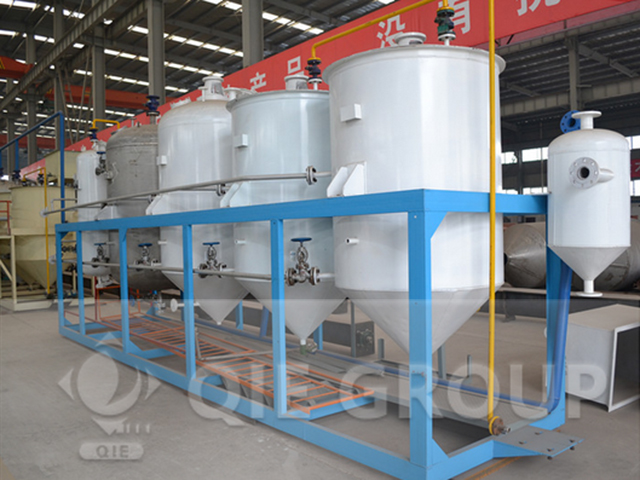
II. Semi-continuous sesame oil refining unit (large-scale industrial production line)
Working principle
Crude oil is continuously transported, and each refining section operates synchronously and without interruption. Degumming, deacidification, decolorization, deodorization, and dewaxing units are connected in series, with oil automatically flowing from one section to the next. The entire process is PLC-controlled automation, with real-time online monitoring of temperature, vacuum, and acid value. Materials are continuously fed in, and refined oil is continuously output, while byproducts such as soapstock and bleaching clay residue are continuously discharged.
Core advantages
✅ High degree of automation, stable and continuous 24-hour production, and lower energy consumption per unit product.
✅ The product quality is highly stable, with minimal fluctuations in oil indicators, making it suitable for large-scale standardized bottled oil production.
✅ With fewer labor requirements and lower labor costs, it is suitable for large-scale turnkey export projects.
✅ Vacuum-sealed continuous processing reduces contact between oils and air, protecting the quality of the oils.
Limitation
It requires high equipment investment and a larger footprint, making it suitable for stable and continuous large-order production, but lacking flexibility in switching between small-batch and multi-variety production.
Applicable Scenarios
A large-scale sesame oil processing plant with a daily output of over 10 tons, a large-scale export bottled refined sesame oil project, and a large-scale oilseed deep processing industrial park.
Reference parameters
| project | parameter |
|---|---|
| Processing capacity | 10–50 tons/day (expandable) |
| Material | Main section 304 food-grade stainless steel |
| Control method | PLC fully automatic control, online monitoring |
| working methods | Semi-continuous automated production |
| power supply | 380V/50Hz, supports overseas voltage customization |
Functional Description of Core Sections of Refining Unit
- Degumming section: Removes phospholipids and gums to prevent oil from becoming cloudy and rapidly oxidizing and deteriorating.
- Deacidification section: Reduces free fatty acids, controls acid value, meets national standards for edible oil, and reduces rancidity.
- Decolorization stage: adsorbs pigments and trace metal impurities, changing the oil from dark yellowish-brown to light golden yellow.
- Deodorization section: High-temperature vacuum removal of odors and peroxides, eliminating unpleasant smells from the oil.
- Dewaxing section: Low-temperature crystallization separates sesame wax, resulting in clear and non-turbid finished oil, which is a key process for export oil products.
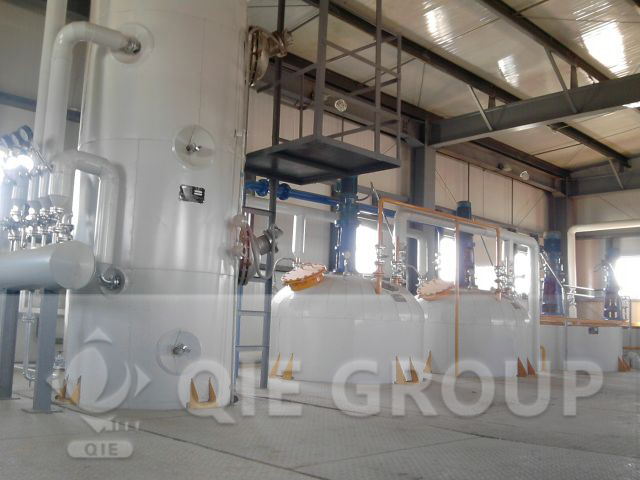
Features
✅ All parts of the equipment that come into contact with oil are made of 304 food-grade stainless steel, which meets food safety production standards.
✅ The closed-loop vacuum process reduces oil oxidation and preserves essential nutrients; solvent-free refining and a safe physical + alkali refining process.
✅ Two models are available, covering everything from small and medium-sized oil refineries to large industrial production lines.
✅ The modular design allows customers to purchase only individual sections as needed (such as degumming and decolorization), without having to buy the entire system at once.
✅ This machine is multi-functional; in addition to sesame oil, it can refine peanut oil, rapeseed oil, sunflower seed oil, rice bran oil, and other vegetable oils.
✅ The by-product soap residue can be recycled, improving the overall profitability of the production line.
Applicable industries
Export-grade bottled sesame oil processing plant, hulled sesame deep processing enterprise, large and medium-sized edible oil refining plant, and global turnkey project for complete oilseed equipment.
FAQ
Q1:Do all sesame oils need to be refined?
A:No. Traditional stone-ground sesame oil relies on roasting the seeds to create its unique caramel aroma. Refining will destroy this aroma, so refining is not recommended. Refining units are used for hulled sesame pressed oil and export-grade bottled first-grade sesame oil to meet physicochemical standards and extend shelf life.
Q2:How to select batch and semi-continuous refining units?
A:For daily production of less than 10 tons, small-batch production of multiple varieties, and limited budget, choose intermittent refining units; for daily production of ≥10 tons, large-scale stable production, and export of standardized bottled oil products, prioritize semi-continuous refining units.
Q3:Does the flavor of sesame oil change after refining?
A:Yes. High-temperature vacuum deodorization removes most of the rich, caramelized aroma produced during roasting, resulting in a lighter color and milder flavor—typical characteristics of Grade 1 edible oil according to national standards. If customers prefer a traditional, rich aroma, refining is not recommended.
Q4:Can the equipment be purchased separately for a single work section?
A:Yes, modular procurement is supported. For example, if a customer only needs the degumming and decolorizing stages but not the deodorization and dewaxing stages, modules can be customized as needed. Alternatively, they can be packaged with front-end cleaning, roasting, pressing, and filtration equipment to form a complete production line, providing workshop layout, process solutions, and turnkey projects.
Q5:How to deal with the soap residue and white clay residue produced during refining?
A:Soap residue can be used to produce fatty acids; waste bleaching clay can be pressed to recover residual oil and used as fuel, realizing the resource utilization of by-products and improving the overall benefits of the project.