


Sesame Oil Refining Process
Sesame Oil Refining Process: Complete Guide to Refining Sesame Oil
Introduction
Sesame oil is valued for its distinctive flavor, nutritional properties, and high content of unsaturated fatty acids. However, crude sesame oil obtained after pressing still contains various impurities that can affect its appearance, flavor, stability, and storage life.
The sesame oil refining process is designed to remove these unwanted substances while preserving as much of the valuable oil as possible. Depending on the quality of the crude oil and the requirements of the final product, the refining process may include degumming, neutralization, bleaching, deodorization, and optional winterization.
For a commercial sesame oil factory, choosing the right refining process and equipment is important because refining affects not only final oil quality but also oil loss, energy consumption, operating costs, and production capacity.
This guide explains how sesame oil is refined, what equipment is required, and how to choose a suitable sesame oil refinery plant for different production requirements.

Why Does Sesame Oil Need to Be Refined?
Where Does Crude Sesame Oil Come From?
Before entering the refinery, sesame oil is generally produced through mechanical extraction.
The two common production routes are:
Cold Press Sesame Oil
Cold pressing uses relatively low-temperature mechanical extraction and is commonly selected for premium and minimally processed sesame oil.
Read our detailed guide:
Cold Press Sesame Oil Process
Hot Press Sesame Oil
Hot pressing uses controlled seed roasting before mechanical extraction. It generally provides higher oil recovery and develops a stronger roasted sesame aroma.
Read our detailed guide:
Hot Press Sesame Oil Process
Both types of crude oil can be further processed in a sesame oil refinery, although the refining conditions may need to be adjusted according to crude oil quality.
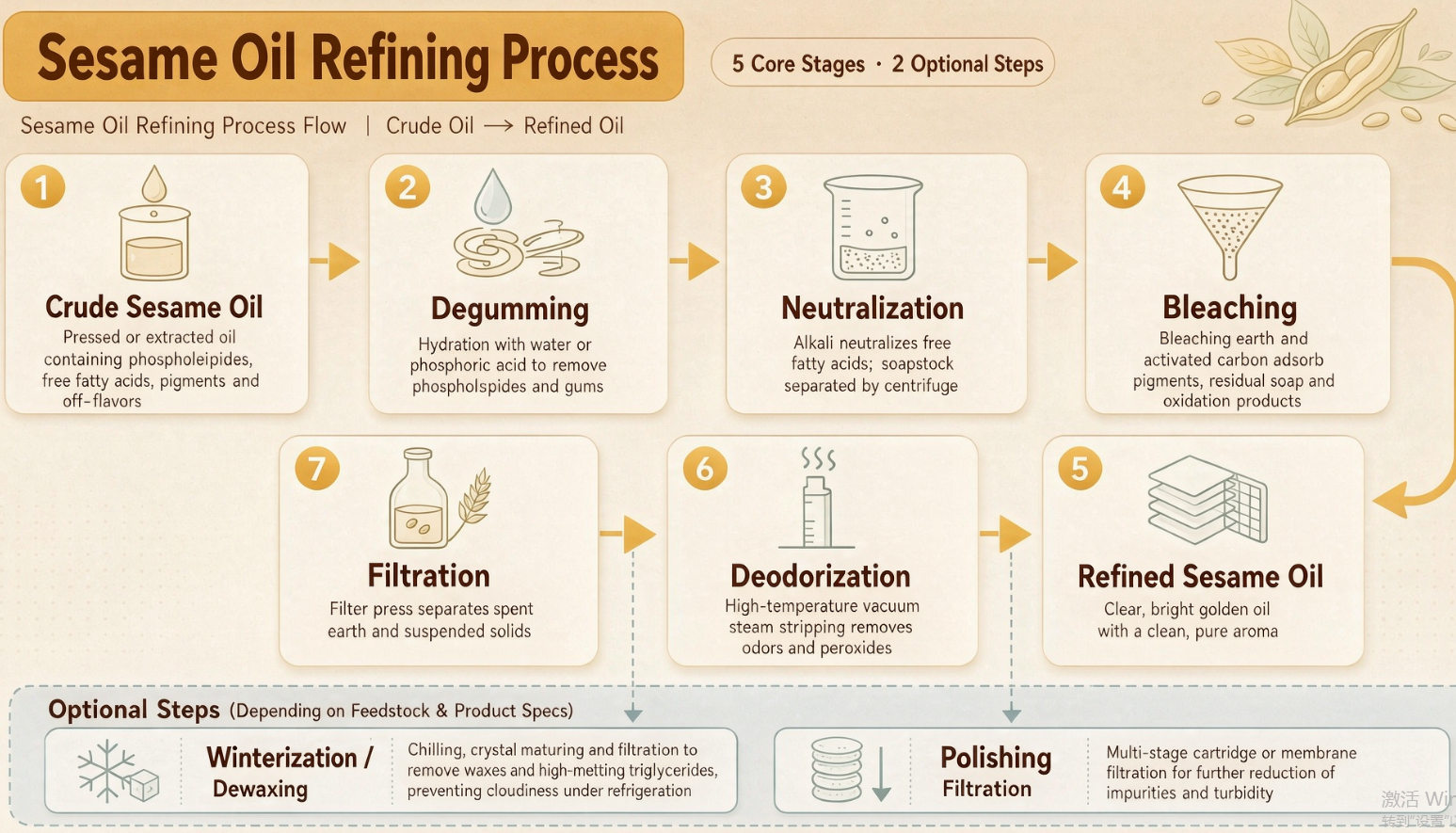
Sesame Oil Refining Process Flow
A typical sesame oil refining process may follow this sequence:
Crude Sesame Oil → Degumming → Neutralization → Bleaching → Filtration → Deodorization → Refined Sesame Oil
Depending on the raw oil and final product requirements, some plants may add additional treatment such as winterization or specialized filtration.
Each stage has a different purpose.
Step 1: Degumming
Degumming is usually the first major refining stage.
Crude sesame oil may contain phospholipids and other gum-forming substances. If they remain in the oil, they can cause:
- Cloudiness
- Sedimentation
- Darkening
- Poor storage stability
- Problems during downstream refining
During degumming, water and/or suitable conditioning agents are introduced under controlled conditions to hydrate or separate the gums.
The separated gums are then removed from the oil.
Main Objectives of Degumming
The process helps:
- Reduce phospholipid content
- Improve oil stability
- Prepare the oil for subsequent refining
- Reduce fouling of downstream equipment
For some crude oils, the degumming process may be adjusted according to the phospholipid content and the desired final oil quality.
Step 2: Neutralization
Neutralization is primarily used to reduce free fatty acids (FFA) in crude oil.
High levels of free fatty acids can negatively affect:
- Taste
- Odor
- Oxidative stability
- Final product quality
In conventional chemical refining, an alkaline solution such as caustic soda is added under controlled conditions.
The alkali reacts with free fatty acids and converts them into soapstock, which can then be separated from the oil.
Key Factors Affecting Neutralization
The process needs to consider:
- Initial FFA content
- Oil temperature
- Alkali concentration
- Mixing intensity
- Reaction time
- Desired final FFA level
Over-treatment can increase neutral oil loss, while insufficient treatment may leave excessive free fatty acids in the product.
Therefore, accurate process control is essential for achieving a good balance between oil quality and refining yield.
Step 3: Washing and Drying
After neutralization, the oil may contain residual soap and other water-soluble impurities.
Water washing can help remove these substances.
The oil is then dried to remove residual moisture before entering the bleaching stage.
Effective drying is important because excessive moisture can reduce bleaching efficiency and negatively affect the performance of bleaching earth.
Step 4: Bleaching
Bleaching is one of the most important stages in sesame oil refining.
Despite its name, bleaching does not simply “wash” the oil. It mainly uses adsorbent materials to remove unwanted color bodies and trace impurities.
Common adsorbents include:
- Activated bleaching earth
- Activated carbon
- Other specialized adsorbents
What Does Bleaching Remove?
Depending on the crude oil quality and adsorbent used, the bleaching stage can help reduce:
- Carotenoid pigments
- Chlorophyll
- Trace metals
- Residual soap
- Oxidation products
- Other polar impurities
The oil and adsorbent are mixed under controlled temperature and vacuum conditions.
After sufficient contact time, the spent bleaching earth is removed through filtration.
Step 5: Filtration
After bleaching, the oil contains spent adsorbent that must be removed efficiently.
A leaf filter or another suitable filtration system is commonly used for this purpose.
Good filtration is important because residual bleaching earth can affect:
- Oil clarity
- Color
- Oxidative stability
- Downstream deodorization equipment
The filtration system should also minimize the amount of oil retained in the spent bleaching earth to reduce refining losses.
Common Equipment
- Pressure leaf filter
- Fine filter
- Safety filter
For larger plants, multiple filtration units may be configured to maintain continuous or semi-continuous operation.
Step 6: Deodorization
Deodorization is usually the final major stage of physical refining.
Even after previous refining stages, sesame oil may contain volatile compounds that contribute to unwanted odors or flavors.
Deodorization uses:
- High temperature
- High vacuum
- Steam stripping
to remove volatile odor compounds.
Main Functions
Deodorization helps reduce:
- Unwanted odors
- Volatile flavor compounds
- Residual free fatty acids
- Certain low-boiling impurities
The final oil becomes cleaner in taste and odor and more suitable for applications where a neutral sensory profile is required.
However, sesame oil is often valued for its characteristic aroma. Therefore, deodorization conditions should be carefully selected rather than simply maximizing odor removal.
Step 7: Optional Winterization
Winterization is not required for every sesame oil product.
It may be considered when the final product needs better low-temperature clarity.
The process selectively removes higher-melting components that may crystallize when the oil is exposed to lower temperatures.
Winterization can be useful when:
- The oil must remain clear during cold storage.
- The product is intended for specific markets.
- The final application requires improved cold stability.
Whether this stage is necessary should be determined by crude oil characteristics and product specifications.
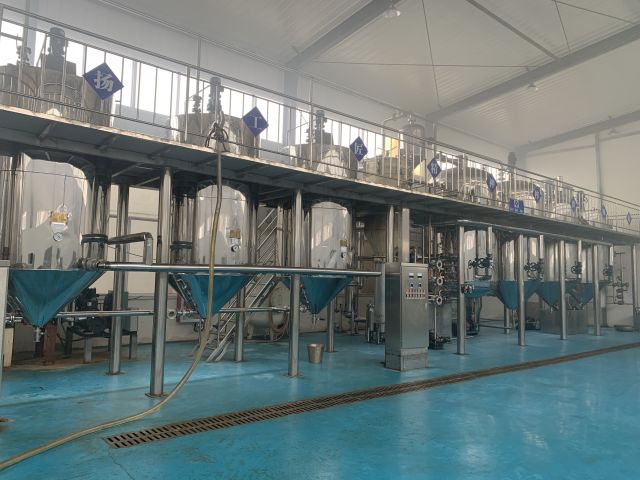
Does Every Sesame Oil Require Full Refining?
Not all sesame oil needs to undergo a complete refining process. The appropriate processing method depends on the product’s positioning, quality requirements, and target market. For traditional or premium sesame oil products, manufacturers often adopt a simple process of pressing, filtration, and storage, which helps preserve the natural aroma, flavor, and nutritional characteristics of sesame oil. This type of oil is especially popular among consumers who value authentic taste and traditional production methods.
In some cases, producers choose a partial refining process, applying only selected refining stages to remove impurities, improve clarity, and enhance storage stability while retaining much of the oil’s original flavor profile. This approach provides a balance between product quality and natural sensory characteristics.
For large-scale commercial cooking oils, export-grade products, and standardized bottled sesame oil, full refining is often the preferred solution. A complete refining process can effectively remove free fatty acids, pigments, odors, trace impurities, and other undesirable components, resulting in a cleaner appearance, longer shelf life, and more consistent product quality.
When determining the most suitable refining configuration, several factors should be carefully evaluated, including the quality of the raw sesame seeds, the oil extraction method, free fatty acid (FFA) content, oil color, target market requirements, product specifications, and local food regulations. Selecting the right refining process ensures that the final sesame oil meets both quality expectations and commercial objectives.
Batch vs Semi-Continuous vs Continuous Sesame Oil Refinery
The refining process itself can be configured in different ways.
Batch Sesame Oil Refinery
Batch refining processes a fixed quantity of oil at a time.
Advantages
- Lower initial investment
- Flexible production
- Easy to change between different oils
- Suitable for smaller factories
Batch systems are often suitable for small-scale sesame oil businesses and projects with variable production volumes.
Semi-Continuous Sesame Oil Refinery
A semi-continuous refinery combines batch-style processing with more continuous material handling.
Advantages
- Higher production efficiency
- Better process stability
- Reduced manual operation
- Flexible capacity
- Easier expansion
It is suitable for medium-sized sesame oil processing plants that need higher efficiency without the investment level of a large continuous refinery.
Continuous Sesame Oil Refinery
Continuous refining is designed for large-scale plants requiring stable and high-volume production.
Advantages
- High processing capacity
- Consistent process conditions
- High level of automation
- Lower labor requirements per ton
- Suitable for long operating hours
Continuous refining is generally more appropriate for large commercial edible oil manufacturers.
How to Choose the Right Sesame Oil Refinery
There is no single refinery configuration suitable for every project.
The decision should consider:
1. Processing Capacity
For example:
- Small projects: approximately 1–20 TPD
- Medium projects: approximately 20–50 TPD
- Large projects: 50 TPD and above
These ranges are only general planning references. The actual equipment configuration should be determined from the required daily throughput and operating schedule.
2. Crude Oil Quality
The initial:
- FFA
- Phosphorus
- Moisture
- Color
- Impurity level
will affect the required refining process.
3. Final Product
A premium traditional sesame oil may require a different process from neutral cooking oil.
4. Investment Budget
Small businesses may start with a batch refinery and upgrade capacity later.
Larger manufacturers may benefit from semi-continuous or continuous systems from the beginning.
5. Utility Availability
The refinery design should consider:
- Steam supply
- Electricity
- Cooling water
- Vacuum system
- Process water
- Fuel availability
These utilities have a direct impact on operating costs and plant layout.
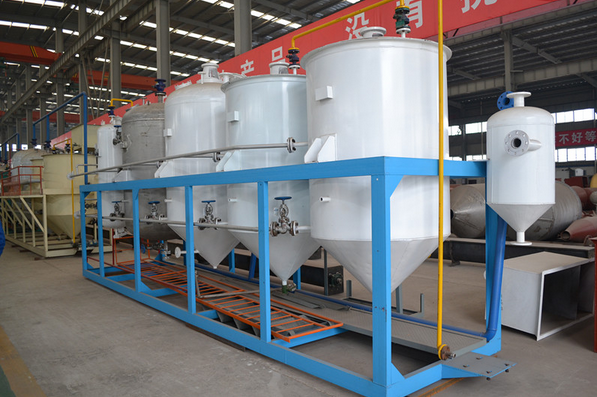
Main Equipment in a Sesame Oil Refinery
A typical sesame oil refinery may include:
Degumming System
Used for phospholipid and gum removal.
Neutralization System
Used for free fatty acid reduction in chemical refining.
Bleaching System
Used for pigment and trace impurity adsorption.
Leaf Filter
Used to separate spent bleaching earth from oil.
Deodorization System
Used to remove volatile compounds under vacuum and steam stripping conditions.
Vacuum System
Maintains the required vacuum during drying, bleaching, and deodorization.
Heat Exchanger
Used for controlled heating and heat recovery between process streams.
Storage Tanks
Used for crude oil, intermediate oil, and refined oil storage.
The final equipment list should be customized according to the selected refining technology and production capacity.
How to Reduce Oil Loss During Refining
Oil loss is one of the most important economic factors in refinery operation.
Major sources of loss may include:
- Soapstock
- Spent bleaching earth
- Filtration losses
- Deodorizer distillate
- Oil remaining in pipelines and equipment
To improve refining yield, manufacturers should focus on:
Accurate Chemical Dosing
Excessive alkali or adsorbent can increase neutral oil loss.
Efficient Filtration
Good filter design reduces oil retained in spent bleaching earth.
Optimized Deodorization
Excessive temperature, steam, or residence time can increase unnecessary losses.
Proper Process Control
Temperature, vacuum, flow rate, and chemical dosage should be monitored consistently.
A well-designed refinery should balance oil quality, refining yield, energy consumption, and operating cost rather than focusing on only one parameter.
Sesame Oil Refinery for Different Production Scales
Small Sesame Oil Refinery
Suitable for:
- Small oil mills
- Start-up businesses
- Local brands
- Agricultural cooperatives
A batch-type system is often a practical choice because it provides flexibility with relatively low investment.
Medium-Scale Sesame Oil Refinery
Suitable for:
- Regional edible oil manufacturers
- Growing sesame oil brands
- Commercial processing plants
A semi-continuous refinery can provide a useful balance between investment and production efficiency.
Large Sesame Oil Refinery
Suitable for:
- Industrial edible oil manufacturers
- Export-oriented factories
- Large food processing companies
Continuous refining offers higher automation and stable high-volume production.
Cold Press, Hot Press, or Refining: How Do They Work Together?
These processes are not necessarily competing technologies.
They can form different parts of the same sesame oil production project.
Option 1: Premium Cold-Pressed Sesame Oil
Cleaning → Cold Pressing → Filtration → Bottling
Suitable for premium and minimally processed products.
Option 2: Commercial Hot-Pressed Sesame Oil
Cleaning → Roasting → Hot Pressing → Filtration → Bottling
Suitable for products where strong flavor and high oil recovery are priorities.
Option 3: Refined Sesame Oil
Cleaning → Hot/Cold Pressing → Crude Oil Treatment → Refining → Bottling
Suitable for manufacturers requiring standardized appearance, stability, and shelf life.
For more information about the extraction stage, see:
Cold Press Sesame Oil Process and Hot Press Sesame Oil Process
How We Can Customize a Sesame Oil Refinery
Every sesame oil project has different requirements.
The refinery can be customized according to:
- Processing capacity
- Sesame seed variety
- Crude oil quality
- Extraction method
- Desired final oil quality
- Automation level
- Available factory space
- Local steam and power conditions
Before selecting equipment, it is recommended to evaluate the complete process rather than choosing individual machines based only on capacity.
A properly designed system should coordinate oil extraction, refining, utilities, storage, filtration, and finished-product handling as one integrated production line.
Frequently Asked Questions
Can sesame oil be refined after cold pressing?
Yes. Cold-pressed sesame oil can be further refined when the target market requires improved color, stability, or shelf life.
Can hot-pressed sesame oil be refined?
Yes. Hot-pressed sesame oil can undergo conventional refining after mechanical extraction.
Is deodorization always necessary?
No. It depends on the desired flavor profile and final product specifications. Traditional sesame oil may intentionally retain its characteristic aroma.
What is the best refinery type for a small sesame oil factory?
A batch-type refinery is often a practical choice because of its flexibility and relatively lower initial investment.
What is the difference between batch and continuous refining?
Batch refining processes oil in separate quantities, while continuous refining is designed for uninterrupted material flow and higher production capacity.
Can the sesame oil refinery process be customized?
Yes. Refining conditions and equipment configuration should be selected according to crude oil characteristics, capacity, product requirements, and local utility conditions.
Conclusion
The sesame oil refining process plays an important role in converting crude pressed sesame oil into a more stable and commercially standardized edible oil. Degumming, neutralization, bleaching, filtration, and deodorization each target different impurities and quality parameters.
However, the most advanced refinery is not necessarily the best choice for every business. A small local producer may benefit from a flexible batch system, while a large export-oriented factory may require a semi-continuous or continuous refinery.
The right solution should be based on raw oil quality, production capacity, target market, desired oil characteristics, investment budget, and available utilities.
Whether your project starts with cold pressing or hot pressing, a properly designed sesame oil refining system can help improve product consistency, marketability, and overall production efficiency.